


From the end of November, the local geology tends to quickly remind the rider who isn’t careful enough. On the sticky clay of the Île-de-France forests or among the wet roots of the Vosges, the observation is the same for everyone: the terrain no longer forgives equipment mistakes.
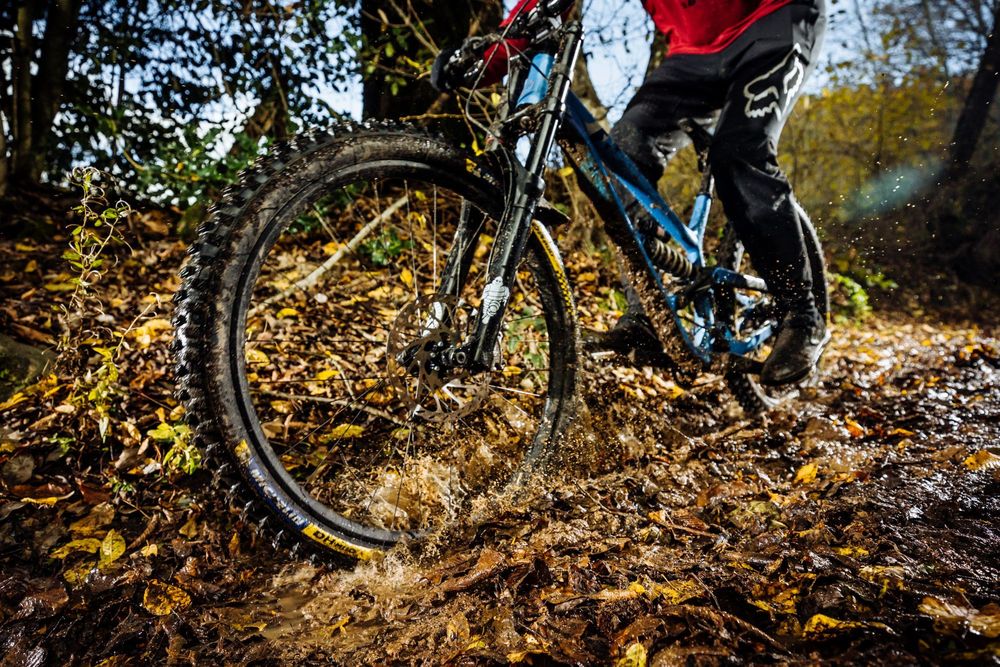
The rear tire slipping on the slightest slope, the front one sliding on a sidehill without warning... these situations don’t necessarily come from a sudden loss of technique. The prime culprit is often a summer tire setup. Perfect for August dust, it loses its qualities in cold and moisture. A standard rubber stiffens and hardens as the temperature drops, losing all grip on wet rock or wood. As for tread blocks that are too close together, they hold soil and instantly turn your wheels into smooth mud blocks (riding GP5000s in a muddy singletrack filled with rocks and roots was never a good idea).
To keep riding safely and maintain some pleasure throughout winter, switching to “adapted tires” isn’t an option, it’s a mechanical necessity. Mud-shedding ability, width, rubber softness: here’s a detailed technical guide to help you choose your winter tires, from cross-country touring to enduro.
The 3 golden rules of winter MTB tires
Before diving into the specifics of each practice, you need to understand the DNA of a good winter or mud tire:
| Clearing | The width | The rubber |
|---|---|---|
| The spacing between the knobs is the number one criterion. A winter tire has tall and widely spaced knobs. The goal? To prevent mud from accumulating and turning your tire into an uncontrollable "slick" (smooth) tire. While riding, centrifugal force must be able to easily eject the earth. | Contrary to what you might expect, in real mud, you ride narrower. If you ride 2.40 or 2.50 in summer, switching to 2.20 or 2.30 allows the tire to "cut through" the soft mud layer to reach the hard ground deeper down. (Exception: on pure snow, you rather seek flotation with very wide tires). | The cold hardens the rubber, which reduces grip on wet roots and stones. Opt for soft rubbers (e.g., MaxxGrip from Maxxis, SuperSoft or Soft from Schwalbe, Magi-X from Michelin). They wear out faster, but in winter, loose earth preserves the knobs. |
Choice by terrain type: each condition has its tire
From November to March, it’s the state of the ground that rules. Here’s how to decode the physical behavior of your tires against the elements to make the right choice.
MTB tires for loose and slightly muddy terrain
This is the classic scenario for 80% of winter rides. The ground is greasy, the humus is soaked with water, and the hard obstacles (roots, rocks, slabs) have become real ice rinks. The mechanical challenge here is not just to dig into the earth, but to find the perfect balance between deformation and support.
Under these conditions, the tire must have intermediate knobs: tall enough to bite into soft earth under braking, but with a base wide enough not to collapse or twist when hitting a root on a slope. The knob spacing is designed to evacuate the sticky layer of mud without creating a total void that would lose contact on hard surfaces.
It’s on these mixed terrains that the softness of the rubber plays its most crucial role. It’s the suppleness of the rubber, not the shape of the knob, that will embrace the micro-roughness of wet rocks where the profile alone would slip. In short: you’re looking for a tire that maintains a minimum pedaling efficiency but whose aggressiveness of the side knobs saves you when the trail gets slippery.
Michelin DH22 Racing Line 29'' MTB Tire Tubeless Ready Foldable Bead to Bead Shield Pinch Protection Magi-X
From €54.99
Michelin Wild XC Performance Line 29'' Tubeless Ready Soft Gum-X E-Bike Ready MTB Tire
From €25.99
Schwalbe Magic Mary 29'' Tubeless Ready Foldable Super Ground Addix Soft E-bike E-50 MTB Tire
From €62.99
Schwalbe Shredda Front 29'' Tubeless Ready Soft Tyre Gravity Pro Radial Addix Ultra Soft E-50
From €69.99
Schwalbe Dirty Dan 27.5'' Tubeless-Ready Mountain Bike Tire, Super Downhill Addix Ultra Soft, E-Bike E-25, Black
From €59.99
Continental Argotal 29'' MTB Tire Tubeless Ready Foldable Downhill Casing SuperSoft Compound E-Bike e25
From €69.99
MTB tires for extreme and deep mud
Here, we switch to the rut of clay soil, the peat bog, or liquid mud. The hard ground has disappeared under a thick slippery layer. A versatile tire saturates instantly and turns into a smooth mud donut, depriving you of all steering and braking.
This is the exclusive domain of the "Mud" (or "Spike") tire. The design is radical: the tire is often narrower (reduced section) to cut through the mass of mud and seek grip on the hard layer beneath, rather than float and slide on the surface. The knobs look like long spikes and are extremely spaced out. This maximum spacing prevents the earth from sticking; at the slightest quick rotation of the wheel, centrifugal force ejects the material (clearing).
The downside is mechanical: these long knobs are blades in the soft, but become real soap bars on the hard. On a rocky slab or compacted support, the long rubber knob bends under your weight and the bike angle. This creates that very tricky "wobbly" sensation and causes violent slips. It’s actually to limit this twisting effect that many top riders like to trim (cut one or two millimeters) the central knobs of their Mud tires with wire cutters, to get a more direct braking on roots while keeping the huge side knobs to anchor in muddy corners.
Michelin Mud Enduro Competition Line 29 MTB Tire Tubeless Ready Folding Gravity Shield Magi-X E-Bike
From €34.99
Michelin DH Mud Racing Line 29'' Tubeless Ready Soft Magi-X DH Cuttable Blocks Downhill Shield E-Bike Ready Mountain Bike Tire
From €49.99
Maxxis Shorty 29 '' Tubeless Ready Flexible Wide Trail (WT) 3C Maxx Grip DD MTB Tire
From €52.99
Continental Hydrotal 29'' MTB Tire Tubeless Ready Foldable Downhill Casing SuperSoft Compound E-Bike e25
From €74.99
The ultimate adjustments for your mud / winter setup
With the right tire setup, the fear of slipping quickly turns into pure pleasure. Always keep in mind your winter triptych: spaced knobs to clear mud, a soft compound for grip in the cold, and lowered tire pressures. Don’t make the mistake of keeping your summer rolling tires "just to see," you might end up hating the season or worse, hurting yourself foolishly on a crooked root.
You just need to take the time to reclaim your summer playground and adapt your choice of rubber to your riding style. One thing is for sure: pedaling efficiency will be lower than in July. Yes, washing your MTB with frozen fingers using a water jet when you get back will take some courage. But the grin under your helmet after landing that insanely technical section will be totally worth it.
So, put on your waterproof pants, check your preventive measures, and get out to ride.
A little doubt about how to change your tubeless tire? Follow our tutorial:

Redac
Author
The Alltricks editorial team: passionate experts sharing blog tests and advice on running (10k to marathon), trail, outdoor activities, and of course, all types of cycling.
View his articles


