


The Salomon Aero Glide 4 GRVL positions itself as a hybrid solution for runners who switch between pavement and forest trails. Equipped with a thick sole favoring cushioning and light studs suitable for unstabilized trails, this model focuses on protective comfort for long outings. This detailed test, conducted by Matthieu, scrutinizes the technical performance and behavior of the shoe on different types of courses.
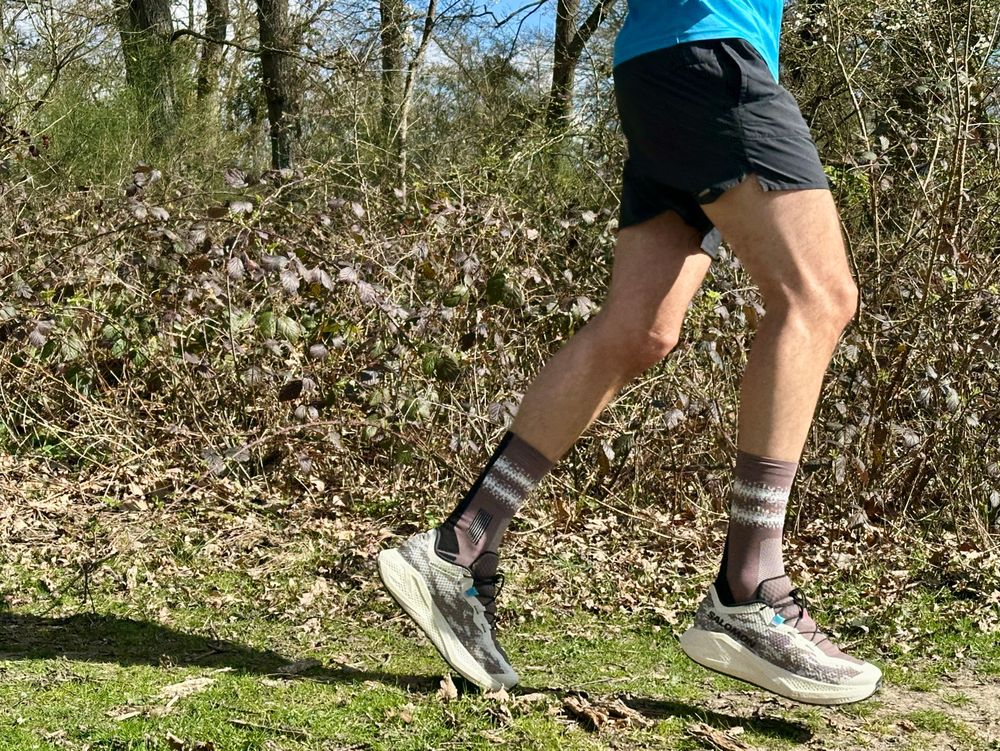
First impressions of the Salomon Aero Glide 4 GRVL
When discovering the Salomon Aero Glide 4 GRVL for the first time, what immediately struck me was the quite thick sole, which gives the impression of a very comfortable shoe. You can feel that it’s a model designed to run long distances without putting too much strain on your legs.
When holding it in my hand, the shoe feels rather light (276g), which surprised me given its size. The fabric seems flexible and pleasant, and overall it gives an impression of quality and durability.
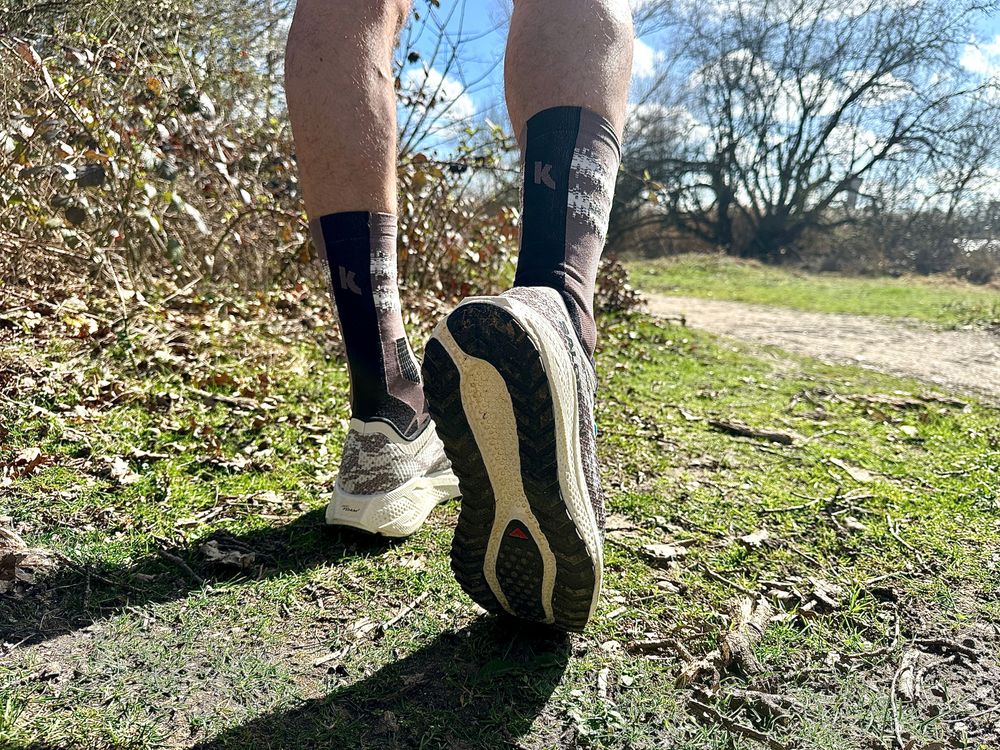
The design is typical gravel and quite dynamic. I also noticed the sole with light studs, which nicely meets the need to alternate between road and trails in the same run. Since I mainly run on mixed routes, this was a point that immediately pleased me.
The gravel positioning announced by Salomon seems consistent with what I see on the shoe. The brand highlights a shoe capable of alternating between road and trails, and that’s clearly the impression it gives as soon as you look at it.
The quite thick sole suggests that it will provide comfort and cushioning over time, while the small studs under the sole show that it is made to leave the road and go on rolling trails.
A well-thought-out design
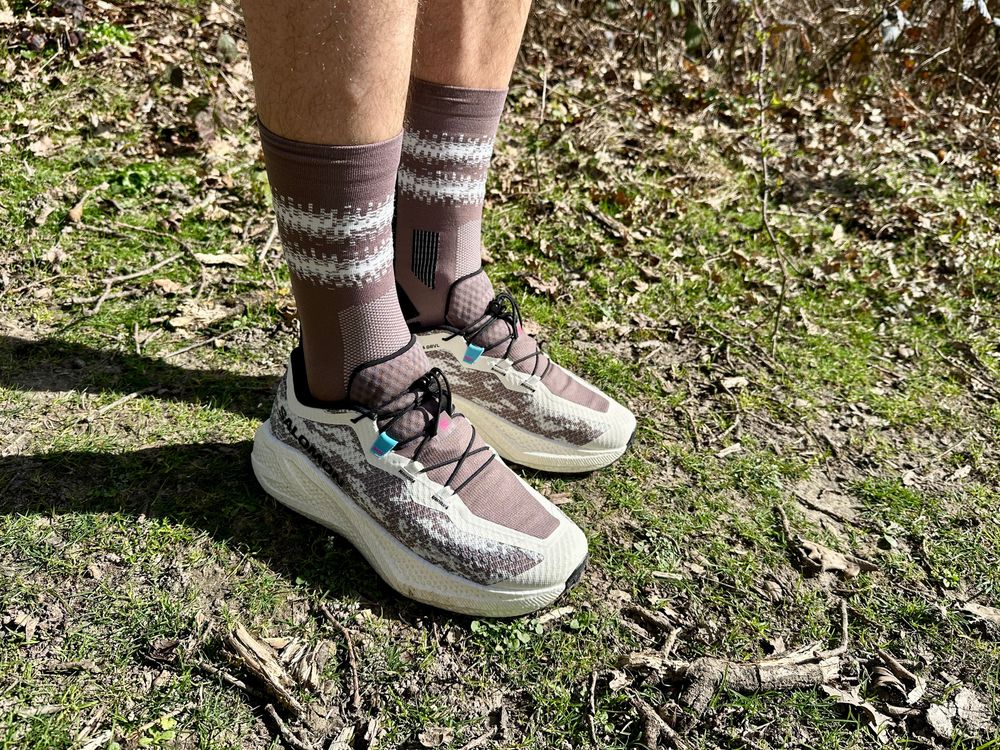
The camouflage colorway is very successful and consistent with the gravel spirit of the shoe. It reinforces the outdoor aspect that the brand promotes.
The shoe also has a fairly dynamic profile, with a well-marked sole giving it a modern and quite pleasant look.
On the other hand, I’m a bit less a fan of the top view. The lacing system and the general look of the shoe seen from above seem a bit less aesthetic compared to the rest of the design.
Overall, I find the design successful and consistent with the shoe’s use, even if some angles are more flattering than others.
Design
Expectations and questions
With this shoe, I mainly expect comfort and versatility. Since I mostly run on mixed routes between road and trails, I want it to be able to easily adapt to both types of terrain without needing to change shoes.
I also hope it will provide good cushioning, especially to protect my legs on slightly longer runs. Having had a TFL syndrome in the past, this is a point I pay particular attention to.
Finally, I expect a stable and pleasant shoe to run in, which allows me to cover kilometers without thinking too much about it. I’m not necessarily looking for a very dynamic model, but rather a reliable and comfortable shoe for my regular runs.
Before trying it, I especially wondered about stability, notably because of the quite thick sole. On some very cushioned models, you can sometimes feel a bit perched, especially on uneven trails.
I also wondered how the shoe would behave on truly mixed terrains. I was curious to see if it would really be comfortable everywhere, or better suited for a particular type of terrain.
Finally, using orthopedic insoles, I wanted to verify if the shoe would offer enough space and remain comfortable with my insoles over time.
Handling the Salomon Aero Glide 4 GRVL
From the very first steps, the shoe is very comfortable. Putting it on is easy and the foot quickly feels well settled in the shoe.
The cushioning is quite soft without being too soft, which gives a pleasant feeling right from the start. I didn’t feel any particular pressure points, and the foot has enough space to stay comfortable.
With my orthopedic insoles, the fit was natural and the shoe remains comfortable from the very first meters. A few pressure points to note though, due to the reduced space for the foot. Overall, the first sensation is really positive and makes you want to go for a run.
Lacing and fitting around the foot
The QuickLACE neo lacing system is really very practical and efficient. It allows you to quickly adjust the shoe and tighten the foot without effort. Once set, the foot and ankle are well supported and you immediately feel confident.
Lacing and foot adjustment
Lacing and foot adjustment
Foot support
The foot support is overall very good. Once the shoe is adjusted, the foot stays well in place and you feel confident while running.
The QuickLACE system really helps to wrap the foot well without needing to tighten excessively. On trails as well as on the road, I didn’t feel any annoying foot movement inside the shoe.
With my orthopedic insoles, the foot is a bit higher in the shoe, which slightly reduces the support around the ankle. Despite that, the support remains good and the shoe stays comfortable and well adjusted during the run.
Foot support
Foot support
The Testing Protocol: 30 km Put to the Test on the Ground
To really understand what this shoe is made of, I took it for 30 km through varied outings. Here are the details of my test conditions:
Terrains: Versatility Above All
I favored mixed terrains, true to my usual practice. The shoe has thus trod on:
- Forest paths with slight elevation.
- Unstable trails (dirt, gravel).
- Some asphalt portions to test the transition. Terrain verdict: It feels particularly "at home" on forest tracks and rolling paths.
Sessions on the Clock
- Nature Run (10 km): In the forest, with a bit of elevation to test grip. Pace: 5’32/km.
- Long Mixed Run (13 km): A mix of trails/road to judge comfort over time. Pace: 5’15/km.
- Active Jog (7 km): On stable terrain. Pace: 5’54/km. > Important note: This run was done with my orthopedic insoles, and foot support remained impeccable.
Weather & Conditions
The test was mainly carried out under bright sunshine (dry weather), with a foray into wet conditions on soft paths to check stability.
Protection: An Effective Shield Against Irregularities
The shoe protects your foot well during the run, especially thanks to the sole’s cushioning which absorbs shocks well, whether on road or trails.
On forest trails and paths with some stones or irregularities, I didn’t feel any particular discomfort underfoot. The shoe filters the small roughness of the terrain well, making running more comfortable.
So you feel quite protected, especially on longer runs or when the terrain is less regular.
Protection
Protection
Support: Confidence in Every Stride
The foot support is overall very satisfactory. Once the shoe is well tightened, your foot stays firmly in place and you feel confident while running.
On forest trails and slightly uneven terrain, I didn’t feel a lack of stability, even in turns or changes of direction. The shoe remains reassuring and the foot doesn’t move inside the shoe.
With my orthopedic insoles, the foot being a bit higher, the ankle support is slightly less pronounced, but it remains completely sufficient for my use on road and rolling paths.
Grip
Grip
Grip and traction: A reassuring versatility
The grip is good on the terrains where I ran. On forest paths and unstabilized trails, the shoe offers reassuring traction and allows you to run with confidence.
During my run in wet conditions on unstabilized paths, I didn’t feel any particular loss of traction. The small studs under the sole provide just the right amount of grip for this type of terrain.
The shoe is still rather oriented towards rolling paths and mixed terrains, but within this context, the grip is perfectly effective.
Grip and traction
Grip and traction
Stability: Controlled balance
Despite the fairly thick sole, the shoe remains overall stable. I felt confident both on the road and on forest trails.
On sections with some elevation or on unstable paths, the shoe stays reassuring and your foot stays well in place. During turns or small changes of direction, I didn’t feel any particular instability.
For a shoe focused on comfort and versatility, the stability is therefore very satisfactory on the mixed terrains I usually practice on.
Stability
Stability
Cushioning: The Balance Between Comfort and Responsiveness
The shoe offers a very good balance between comfort, stability, and dynamism. The cushioning is well present both at the front and at the back, which makes running pleasant, especially on trails or longer runs.
Despite this quite comfortable cushioning, the shoe maintains sufficient dynamism, especially when running on the road. Your stride remains smooth and you can easily pick up the pace without feeling like you're in an overly soft shoe.
Ultimately, it’s a successful balance between protection and responsiveness, which suits well for use on mixed terrains.
Cushioning
Cushioning
Breathability: Your Foot Stays Dry
The shoe’s breathability is good. During my runs, I didn’t feel any sensation of my foot being too hot, even after several kilometers.
The shoe’s fabric seems to let air circulate well, which helps keep your foot fairly comfortable during effort. During my run in humid weather, the shoe also managed the moisture well without giving a feeling of a wet or unpleasant foot.
Breathability
Breathability
General impressions
Width and fit: Precision for narrow feet
Having fairly narrow feet, I felt well supported in the shoe. The fit seems well suited for narrow to normal feet, with a good balance between support and comfort. Throughout all my runs, my foot stayed well in place and I didn’t feel any lack of stability.
However, I did feel a slight discomfort at the left big toe during my three runs. It remains light, but this is the only comfort issue I noticed. Apart from that, the overall foot support is good and the shoe stays pleasant to run in.
Focus on size and insoles
I usually take a size up to be more comfortable and to be able to insert my orthopedic insoles.
With my insoles, the size is perfect and the foot remains comfortable during running. Without the insoles, I probably could have taken half a size less rather than a full size up.
Durability: What prospects?
It is still a bit early to precisely judge the model’s durability, given the limited number of kilometers run so far.
However, the materials and construction give a good impression of solidity. The sole and the fabric of the shoe seem resistant and well designed.
I remain curious to see how the shoe will hold up over time, especially with regular runs on trails and sometimes slightly rough terrain. So far, I have not noticed any signs of premature wear.


