
Norda Test 001A: Durability, Vibram grip, and stability put to the test after 200 km on technical terrain
27 juillet 2026 / Redac , Author


The Norda 001A intrigues with its high-end positioning, its price, and a promise: to last.
I ran with it for several weeks, three to four sessions per week, for a total of about 200 km. I tested it on my usual terrains: rolling forest paths, trails, roots, technical singles.
Here is the assessment after 200 km.
Design and first impressions: The promise of Dyneema
From the moment you hold it, the Norda 001A gives a real impression of quality. The upper made of Dyneema, a very resistant material usually found in outdoor gear or sailing, immediately gives a different feeling under your fingers. Nothing like the trail shoes I tried before.
The design remains sober, without unnecessary frills. You feel that each element has a function rather than just being there for aesthetics.
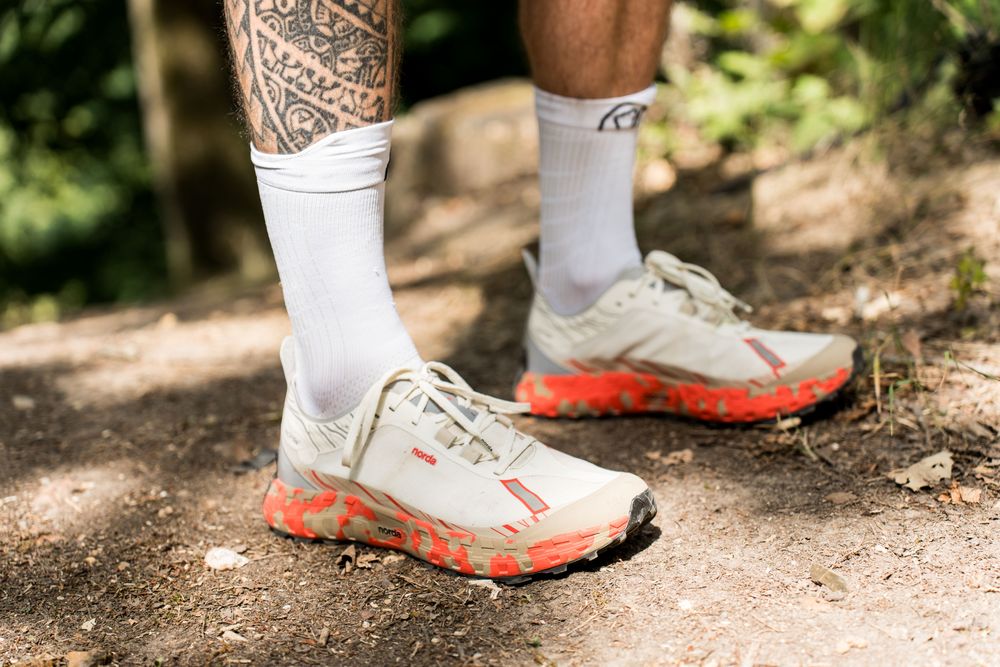
Design
The shoe’s construction is careful, the materials are out of the ordinary, The design is sober and elegant
Before running with it, I had three questions in mind: comfort on long runs, behavior on technical terrain, and especially the real durability compared to a more classic pair. At this price, the last question matters more than the others.
On foot, the fit wraps well. I appreciate this type of tight support when the terrain gets technical, it limits bad surprises in footing. No hot spots, no friction after several runs. Over 200 km, I had neither blisters nor particular discomfort.
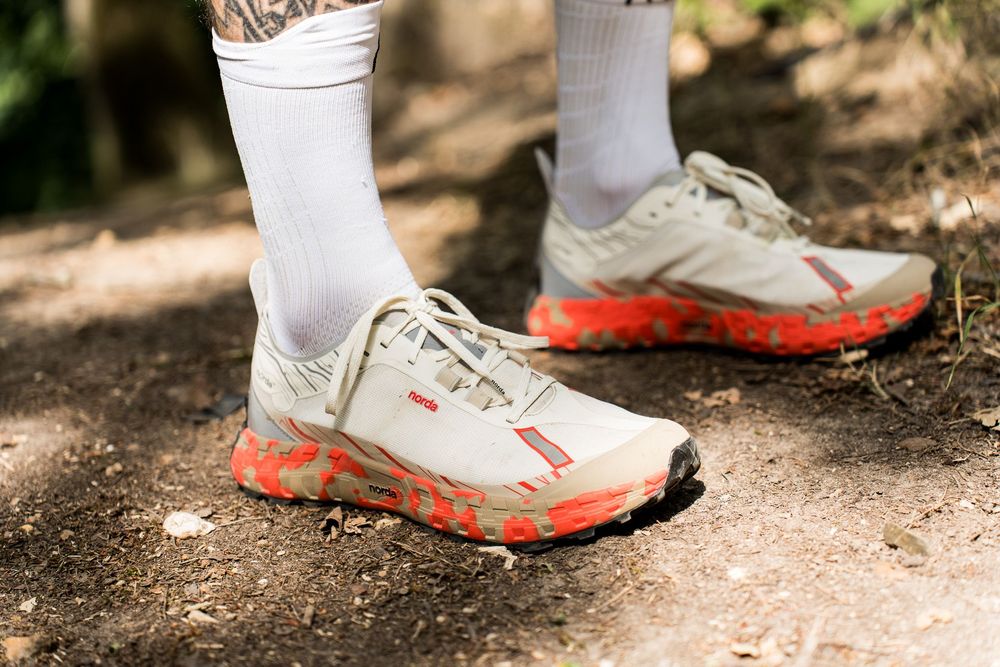
Support
The foot does not move once laced, even on uneven terrain.
The real test: 200 km on my trails
Nothing special in the test conditions. Forest trails around my home, alternating between rolling sections and singles with roots and changes of direction. I wore it like a classic training shoe. On rolling terrain, it does the job without particularly standing out. It’s on technical terrain that it becomes interesting.
Protection: The right balance to keep the feel of the ground
On rocks and roots, the protection is good without giving the impression of running on a smoothed surface. You can still feel where you place your foot, which is important to me on technical descents.
Protection
Good protection without cutting the sensations of the ground, a balance I appreciate.
Grip: A Vibram sole that immediately inspires confidence
This is one of the aspects that impressed me the most. On dirt, roots, and technical singles, I was rarely caught out during these 200 km. A Vibram sole is not just about the depth of the lugs: above all, it must give enough confidence to stop thinking about your footing and focus on the trajectory, and that’s where it really stands out. On descents, I can commit my footing without hesitation, even when accelerating on a single track, it remains predictable.
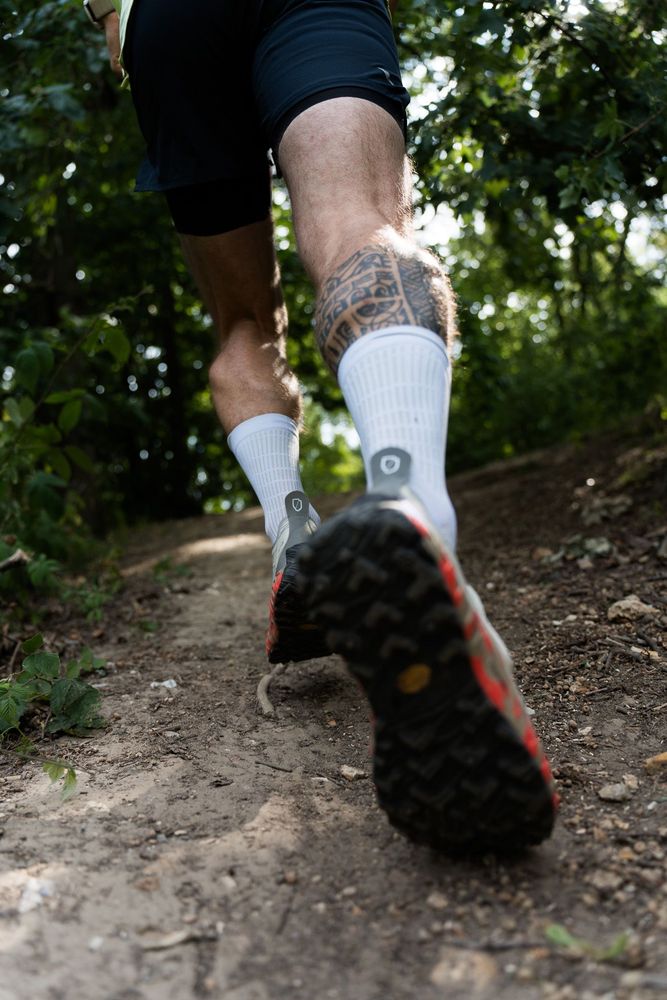
A stable and reassuring shoe
no slipping felt even on fast descents, the shoe remains predictable in changes of direction. This is the clearest strong point of this test.
Dynamism and rebound: A surprising responsiveness for a model focused on durability
Good surprise on this point. A brand that communicates so much about durability often makes you fear a shoe that's a bit soft. That's not the case here. It responds well to acceleration, including after a technical turn or a hill rebound. I think this is a shoe that isn't aimed at pure competition, but the balance between comfort and dynamism works well, to the point that I wore it three to four times a week without thinking about the choice of the pair. The foot roll remains natural. On smooth trails, I increase the pace without feeling like I'm forcing against the shoe.
Durability: the real topic
This is what everyone expects from a Norda. After 200 km, the upper shows no signs of wear, the studs remain well defined, and the foam hasn't lost its properties.
Durability
No visible wear on the rod, the studs, and the foam after 200 km, which is rare at this stage. This note only applies to the first 200 kilometers, not as a definitive verdict.
My opinion after 200 km
After 200 km, I enjoyed running with this pair, with no particular reservations about the terrain or comfort. What strikes me most is the absence of obvious compromise: neither too soft nor too firm, neither only comfortable on technical terrain without being dynamic on the roads.
I use it three to four times a week without questioning it. The price remains, which would be dishonest to downplay. Durability must be part of the calculation at this price, and for now the signs remain positive. But I won’t claim that the promise is validated after only 200 km: the real answer will come after 500, 800, or even 1,000 km. If the shoe keeps up this pace, the price becomes a secondary detail.
Summary table
| Strengths | Weaknesses |
|---|---|
| Comfort that lasts over time | The price, hard to ignore |
| Very good foot support | Cushioning that may seem too firm for runners looking for softness |
| Solid stability on technical terrain | Real durability still to be confirmed over several hundred kilometers |
| Grip that inspires confidence | |
| Balanced cushioning, neither too soft nor too firm | |
| Surprising dynamism for a shoe oriented towards durability | |
| Good versatility between road and technical terrain | |
| Encouraging first signs of durability |

Redac
Author
The Alltricks editorial team: passionate experts sharing blog tests and advice on running (10k to marathon), trail, outdoor activities, and of course, all types of cycling.
View his articles


